
Adversarial exposure validation

Prove your controls stop real adversaries. Continuously.

Production-safe adversary emulation across IT, cloud and OT, run continuously by AI agents through SCYTHE MCP. Test fast and get a prioritized list of what to fix first.
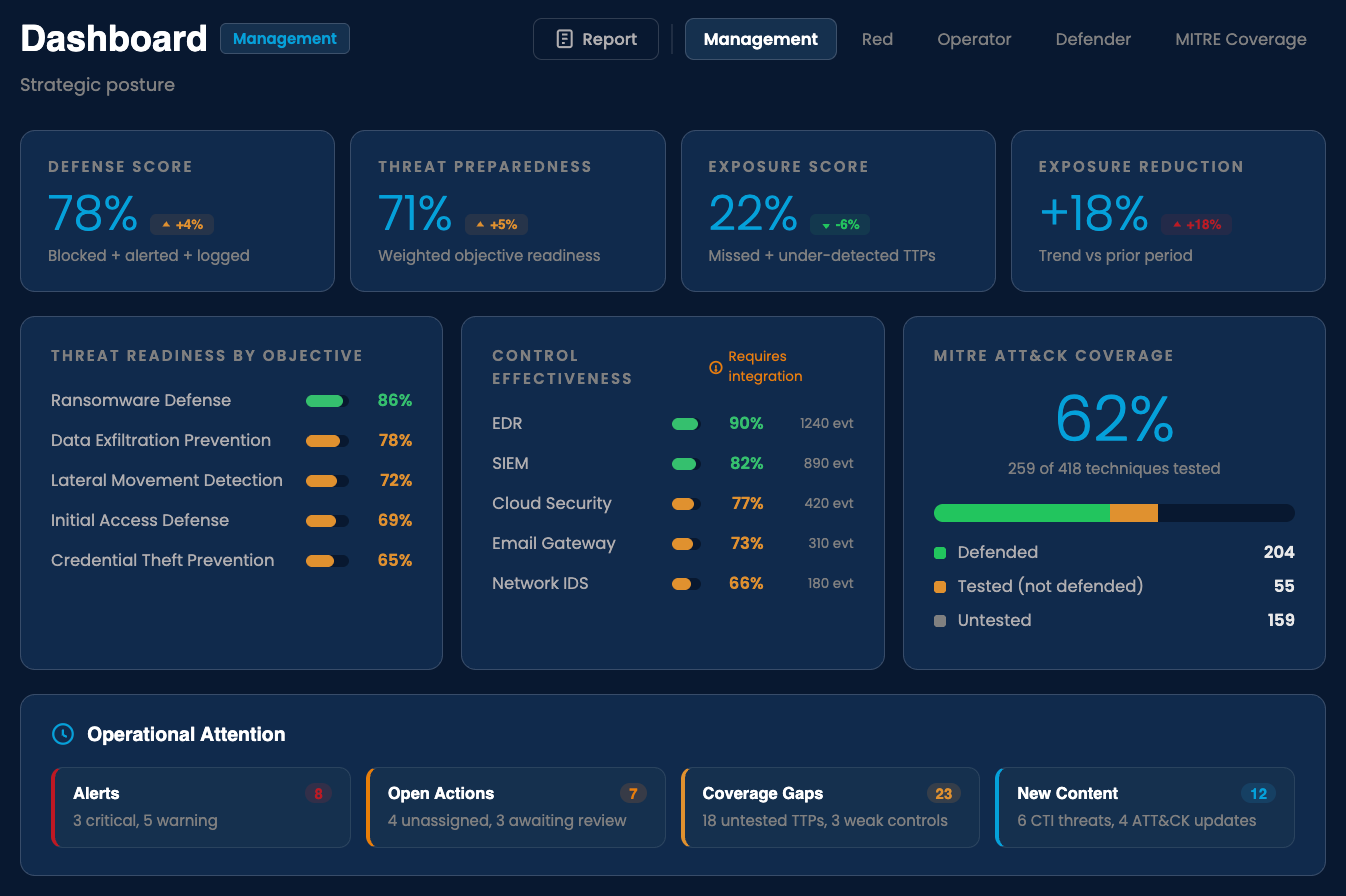
SCYTHE management dashboard: defense score, threat preparedness, exposure score, control effectiveness and MITRE ATT&CK coverage
  • 50–200×

    faster emulation build than by hand, with integrated AI

  • Minutes

    post-exploitation validation, down from days or weeks

  • 60%

    lower mean time to remediate

  • 40%

    coverage improvement in 90 days

  • Production

    safe emulation across IT, cloud and OT

Source: SCYTHE internal benchmarking and customer data, November 2026.

Attackers now use AI agents. Your detections have a shelf life.

Adversaries use AI to scale, move faster and try procedure after procedure until one gets through. Every new technique, EDR update and SIEM rule change can quietly break a detection that worked last month.

Annual pen tests and periodic exercises can't keep pace. Defenders need the same agentic velocity.

Read: why detections have a shelf life →
Activity over 12 months
Adversaries with AI agentsScale, velocity, brute-force variation
Periodic testingAnnual pen test, quarterly exercise
SCYTHE Purple LoopAgentic validation, same velocity

Month 1Illustrative, not measured dataMonth 12

SCYTHE Purple Loop

Four always-on tracks, run by AI agents

Continuous agentic purple teaming. Each track runs at its own tempo, and every finding lands on one prioritized fix list.

  1. 01 · continuous

    Controls validation

    Regression-tests every deployed detection and policy, and catches drift the day it happens.

  2. 02 · daily

    Optimization

    Tunes weak or noisy rules, with guided fixes and detection rule generation.

  3. 03 · daily to weekly

    Gap hunting

    Agents pursue an objective, change tactics and evade detection to find the gaps adversaries will reach for.

  4. 04 · on new intel

    New threats & CVEs

    Turns new threat reports and CVEs into running emulations within hours.

Orchestrated through SCYTHE MCP

  • Anthropic
  • OpenAI
  • Copilot
  • AWS Bedrock
  • …More
How SCYTHE MCP works →
See how the Purple Loop works

Gartner Autonomous Exposure Remediation

Automation without proof is risk. SCYTHE is the validation and verification layer.

Gartner named Autonomous Exposure Remediation a top strategic technology trend for 2027. SCYTHE supports four of the six steps, from discovery through fix verification, running them continuously as the SCYTHE Purple Loop.

01

Inventory

Know your assets.

02 · SCYTHE supports

Discovery

Surface control gaps from new CTI and gap hunting.

03 · SCYTHE supports

Issue validation

Prove it's exploitable, against your controls.

04 · SCYTHE supports

Planning

A prioritized, guided fix list.

05 · SCYTHE supports

Fix verification

Re-test to prove the fix or compensating control held.

06

Remediation

Close it out.

How SCYTHE supports AER and CTEM →

Built by red teamers. Run by anyone.

The Purple Team Exercise Framework (PTEF) is the free framework red, blue and purple teams use to plan and run exercises.

Get PTEF

What our customers say

  • SINET16 2026 HonoreeSINET16 HonoreeTop 16 innovators, 2026
  • SINET16 2025 InnovatorSINET16 InnovatorTop 16 innovators, 2025
  • Global InfoSec Award WinnerGlobal InfoSec AwardCyber Defense Magazine
  • SOC 2 Type IISOC 2 Type IIIndependent annual audit

Questions about adversarial exposure validation.

Something else? Talk to our team.

AEV is the practice of continuously proving which exposures an attacker could actually exploit, by running realistic adversary behavior against your real controls. Gartner uses AEV as the category that brings together breach and attack simulation and automated pen testing and red teaming.

See what your controls actually catch.

Demo

15–60 minutes, at the depth you choose.

Free live assessment

SCYTHE runs one common adversary against your gold image and returns a scored report and risk level in 1–2 hours.